

Before every flight, a short prayer is broadcast in the cabins of Air Arabia’s new Airbuses: a young mullah quietly asks Allah for a safe journey. Passengers settle into their seats and barely pay attention to the melodic recitation coming through the speakers. The flight attendants politely ask everyone to fasten their seatbelts. Ahead lies a long flight to Sharjah — the cultural capital of the Arab world, a resort city where it is summer all year round.
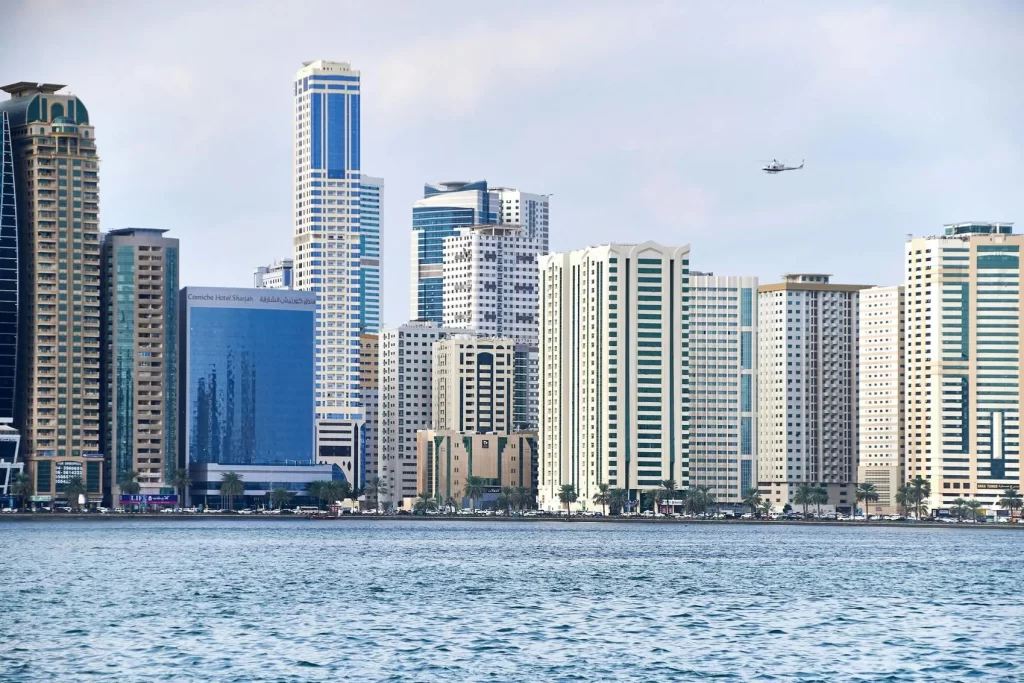
The United Arab Emirates is a deeply religious country. Of the seven emirates that make up the federation, Sharjah is considered one of the most conservative. Great importance is placed here on observing national traditions, and no meaningful undertaking begins without prayer. Yet religiosity coexists harmoniously with scientific and technological progress. Low, squat mosques are surrounded by glass skyscrapers and multi-level interchanges, while modern business centers and boutique malls have dedicated prayer rooms. In every hotel room, a small arrow painted on the ceiling indicates the direction of Mecca — the way a Muslim should face while praying.
The lobby of Sharjah’s most expensive hotel is bustling. Gleaming cars pull up one after another, and men in long white robes step out unhurriedly. They exchange handshakes and, leaning toward one another, lightly touch the tips of their noses — a gesture symbolizing equality and mutual respect. Their host is waiting for them inside. Today is a special day for his family: his son’s wedding.
According to Muslim custom, men and women celebrate separately, so neither the bride nor any female guests are present. The groom is the only one dressed in black — a robe embroidered with gold patterns. He sits modestly off to the side, surrounded by brothers and close friends, and it almost seems that the central figure of the occasion is not the young groom but his father, who is now serving tea to his guests in small cups.
Hotel guests who have happened upon the celebration watch the shy groom with curiosity. Photographing people without permission is forbidden in Sharjah: the law carefully protects the private lives of the emirate’s residents. Gradually, there are no empty seats left in the lobby — by now, nearly two hundred people must have gathered. At last, the host invites everyone to proceed to the restaurant. The guests rise at a leisurely pace and, continuing their conversations, slowly make their way into the next hall. The heavy doors close softly behind them: the main festivities will take place out of sight.
Private life is one of Sharjah’s most closely guarded values. Wealthy citizens shield their everyday lives behind the high walls of private villas. Those who live in apartment buildings keep their blinds closed and curtains drawn to protect themselves from prying eyes. And yet it is precisely this local way of life that draws travelers here from around the world. To satisfy visitors’ curiosity, the Ministry of Culture organizes special talks at cultural centers, where male and female staff members — speaking fluent English — explain Arab traditions and describe the everyday life of an ordinary Arab family, often with humor.

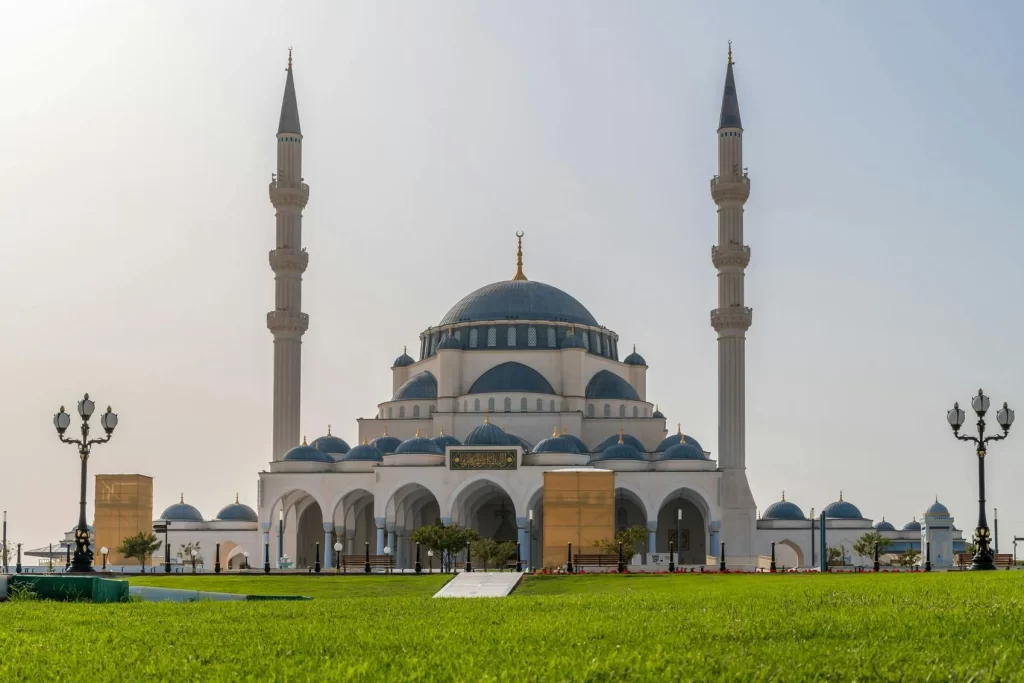
Al Noor was the first mosque in Sharjah to open its doors to non-Muslim visitors. At the entrance, every woman is offered a traditional black garment — the abaya — and a thin black headscarf called a shayla. This is the everyday dress of all Emirati women and of many visiting Muslim women. The mosque provides the clothing free of charge: each abaya comes sealed in a disposable plastic package. Visitors may enter only barefoot, leaving their shoes at the door. The soft, resilient carpet pleasantly tickles the soles, and the soundless steps do not disturb the solemn quiet of the sanctuary.
A modest, smiling woman in glasses stands at the entrance. She looks no different from local Emirati women: she too is covered from head to toe in loose black garments. Her name is Sherifa Majwick, and she is originally from Australia. Now in her forties, she has lived in Sharjah for many years, works at the local Center for Cultural Communication, and leads tours of one of the city’s most beautiful mosques.
Sherifa speaks at length and with enthusiasm about Islam and the Arab world. Gradually, her monologue turns into an animated conversation: the visitors keep asking questions, and she answers each one with evident pleasure and in great detail. “Why do Arab women always wear black?” someone inevitably asks. Sherifa laughs playfully: “Well, isn’t it obvious? Black is slimming — and we think we look good in it.” Then, more seriously, she explains that in the Arab world black symbolizes modesty and equality. A long, loose robe completely conceals a woman’s figure, and in such clothing she feels comfortable — both physically and psychologically.
The laws of the Emirates do not require women to wear national dress at all times or to cover their faces completely, yet the women of Sharjah choose to do so. In summer, when the temperature reaches forty-five degrees, the wide, crease-resistant hems create a light breeze with every step. And the hot sun does not burn the delicate faces hidden behind the black “veil”: Arab women value the fairness of their skin, protect it from tanning, and often use whitening creams.
Men in Sharjah also pay close attention to their appearance. Men’s barbershops — always full — are found at every turn. All local men wear the dishdasha, a straight white robe down to the ankles, and even by the end of the day it remains perfectly clean and smooth. On their heads they wear the ghutra, held in place by the thick black cord called the agal. It is not unusual to see men pause before mirrored shop windows, carefully and unhurriedly straightening the folds of their headcloth.
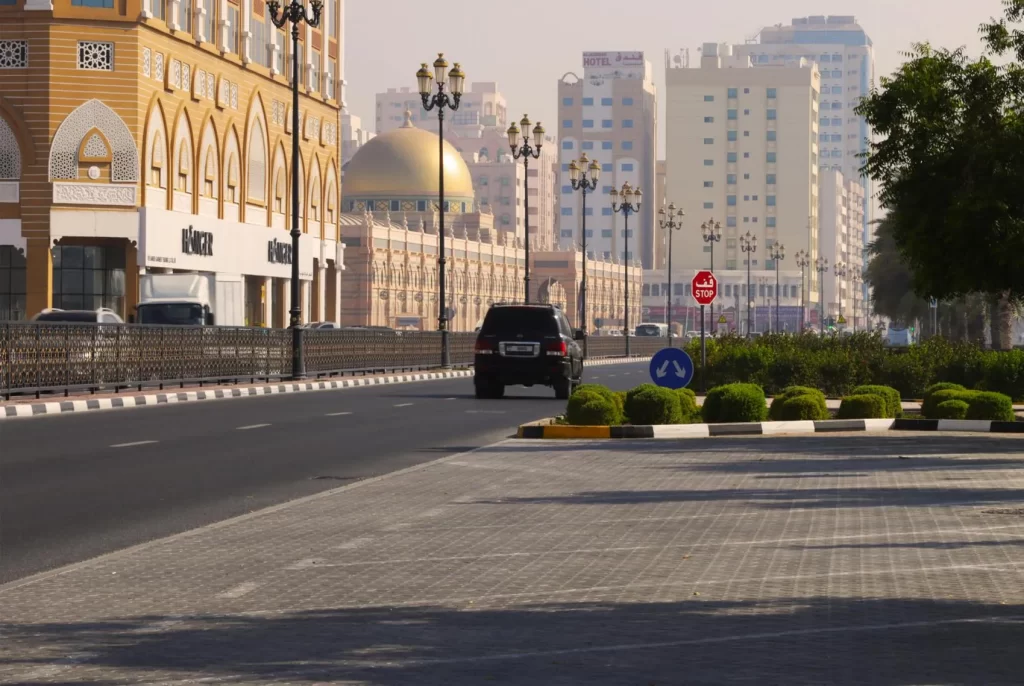
In 1998, Sharjah was declared by UNESCO the Cultural Capital of the Arab World. Today, more than twenty museums are located within the emirate — an absolute record for the UAE. The ruler of Sharjah, His Highness Sheikh Dr. Sultan bin Muhammad Al Qasimi, also serves as the Minister of Education of the United Arab Emirates. The title “Dr.” is not honorary: he holds two doctoral degrees in philosophy from British universities, as well as fourteen honorary doctorates awarded by academic communities across Europe, America, and Asia in various fields.
Each year, Sharjah becomes a major cultural center for the entire Middle East. Every autumn the city hosts the international book fair, bringing together new publications in all the world’s languages. Each winter begins with the Formula 1 Powerboat World Championship. Major events are held here almost continuously: the Festival of Light, a wedding exhibition, Theatre Days, contemporary art exhibitions, watch and jewelry shows, camel races, culinary festivals and water festivals.
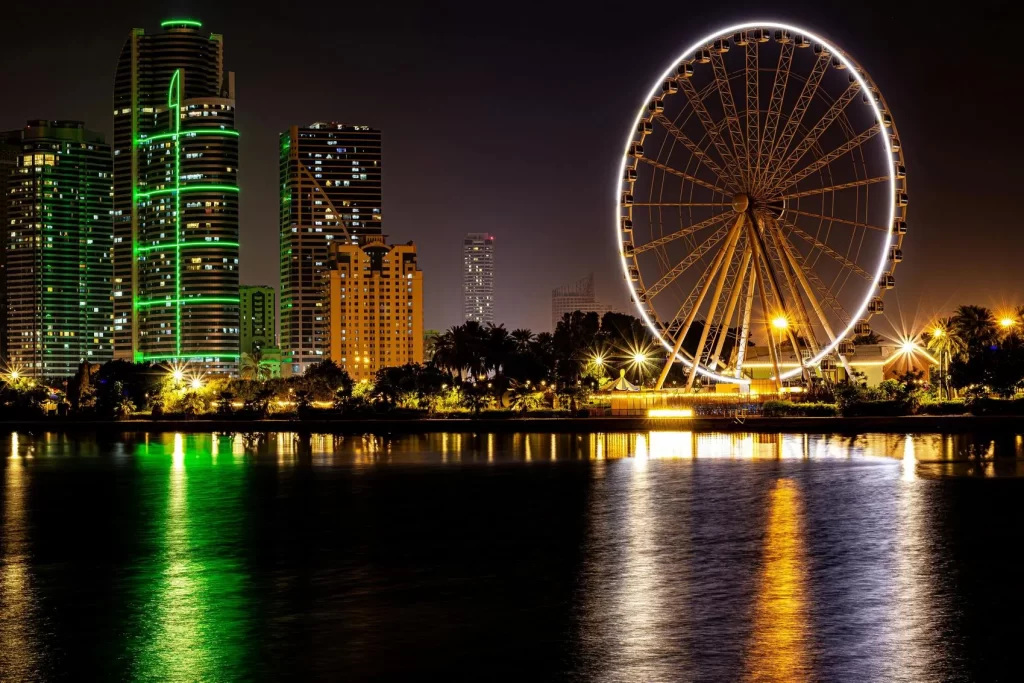
Local guides ask visitors to dress modestly and refrain from wearing short shorts and bare shoulders — out of respect for the country’s traditions, not for safety reasons. Although more than 80% of the population consists of expatriates from India, Iran, Pakistan, and neighboring countries, the UAE is one of the safest countries in the world. The law here works with unvarying precision: any violation is punished, regardless of the offender’s status or nationality.
These restrictions do not complicate life; on the contrary, they make it more comfortable and pleasant. Here, for example, the use of drugs and alcohol is strictly prohibited, as are littering and smoking in undesignated places. At any time of day, Sharjah’s streets are peaceful and clean. Even on weekends, when night cafés and restaurants are crowded until late and local families stroll along the waterfronts, the city remains calm, quiet, and orderly. White sand and warm sea, tranquility, safety, and excellent service — Sharjah has all the essential components of a perfect holiday. Visitors are almost guaranteed to be spared any rudeness: it is not customary to scold strangers, and public arguments are prohibited altogether.
In the city center, at the intersection of its busiest roads, a large sign in Arabic and English reads: “Smile: You Are in Sharjah!” According to Islamic tradition, a smile is considered a form of charity, for it can bring joy, encouragement, inspiration, and even help to another person.
Wherever you travel from the city and wherever you return from, you inevitably pass these giant letters. And every time you see them, you cannot help but smile. Why? The reason is obvious: because you feel comfortable and at ease. And also — because you are in Sharjah.
Text by Yulia Zemtsova
Translated from Russian by Sofia Zemtsova
Cover photo by Asifgraphy