
A journey through Slovenia and Europe’s largest cave
Tiny Slovenia is quiet and almost deserted. In the middle of the day, you can hardly spot a single passerby in its small towns. It makes sense: the population of this country, roughly half the size of Moscow Region, is only about two million, and most of them, it seems, have gone off to work.
On the mountain roads winding past tiny villages, cars are rare, and you can’t shake the feeling that you’ve arrived at the wrong time — either too early or far too late. Empty cafés, shuttered windows, locked gates — not a living soul in sight, and only the bright sun peeks through the winding roads, now into the right window, now into the left.

The true compactness of Slovenia becomes clear when you consider this: in summer, especially on weekends, traffic multiplies many times over as people from neighboring Hungary, Austria, and Italy pass through en route to Croatia, heading for a weekend by the sea. On Fridays, the jams flow one way; on Sundays, the other.
Yet not all travelers pass through Slovenia merely in transit. This is a land of astonishing natural beauty and mysterious mountain caves. There are over ten thousand of them, and many are completely safe and fully equipped for visitors — even those with no prior experience.


Strangely, human efforts to make these places accessible have only enhanced their charm, making them feel even more magical and fairytale-like. For example, Slovenia’s most famous cave, Postojna Cave (Postojnska Jama), owes much of its allure to careful human intervention.
This is Europe’s largest cave, stretching over 24 kilometers, and the only one in the world to contain a railway and electric lighting. It was developed in the 19th century by order of Austro-Hungarian Emperor Franz Joseph I, who visited Postojna Cave twice: first in 1857, and then in 1883.
During his first visit with Empress Elisabeth, 15,000 lamps were installed for them, the faint scorch marks of which can still be seen on the walls. By the emperor’s second visit, the cave had been electrified, and rails had been laid for small tourist trolleys. Interestingly, these trolleys were not powered by electricity; the guides pushed them by hand.
Modern guides proudly recount that the imperial couple walked most of the route on foot, spending several hours exploring the cave — while today, visitors traverse the same path in just ten minutes aboard a mini-train.
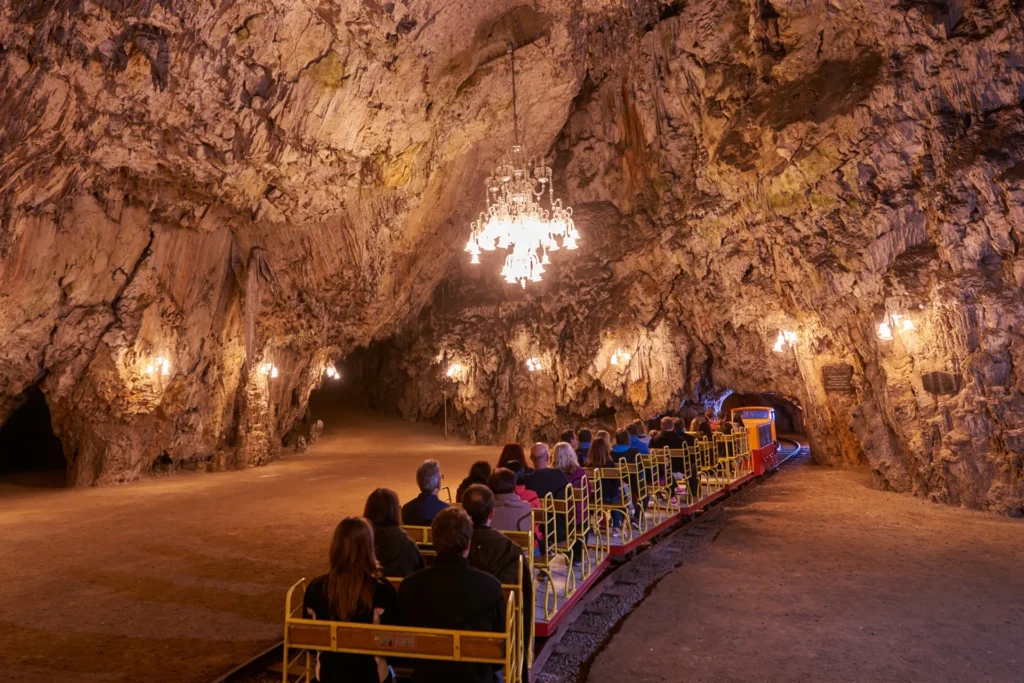
Deeper underground, there’s also a walking trail — though far shorter than the cave itself. Only one-fifth of the cave is open to the public, and independent exploration is prohibited. Touching the walls, the stalagmites rising from the ground, or the stalactites hanging from the ceiling is strictly forbidden. These remarkable formations are tens of thousands of years old, growing at a rate of about one centimeter per century; even the slightest touch can slow or halt their growth entirely.
Breaking the rules of this subterranean realm feels unthinkable. The cave’s majestic, mystical atmosphere inspires almost numinous awe. It is, without exaggeration, another world: earthly, yet unlike anything you’ve ever seen. In the presence of such strange beauty, any lingering doubts about the existence of gnomes, trolls, or even goblins simply vanish. There is a unique order here, a different flow of time and life. That the mythical guardians of this place have allowed humans into their cold halls feels like a true miracle, to be met with gratitude and reverence.


Temperatures never rise above 10 °C, and from time to time, you hear the rare drip of falling water. Soft lighting accentuates the unusual textures of the ceilings, shimmering with moisture and mineral deposits. Everything feels solemn and formidable, yet calm and unthreatening. The tour lasts just ninety minutes, but you wish it could continue longer, allowing you to almost dissolve into the magical atmosphere of the Great Depths.
Although Postojna Cave was known in the Middle Ages, it only became accessible to visitors in the 19th century. Today, it even hosts concerts and events with light installations. For instance, Christmas performances are held annually in the Great Hall, whose extraordinary acoustics are said to amplify the emotional impact of every vocal performance.

Among the cave rules announced before descent is a strict ban on flash photography. The cave is home to over 150 species, many endemic — unique creatures that live their entire lives in darkness. A sudden flash, even for a split second, can be fatal to them.
One such remarkable being is Slovenia’s totem and source of countless legends: the olm (Proteus anguinus), also known as the blind salamander. Unlike legendary salamanders, it lives not in fire but in subterranean waters.

This species is one of the oldest on Earth, having existed for millions of years. Its nickname, the “human fish,” comes from its pale skin, reminiscent of human flesh. Its lifespan is comparable to ours: olms typically live over seventy years, sometimes reaching 100, and attain sexual maturity around twelve.
Completely blind, this curious creature cannot breathe air despite having lungs. It grows up to 30 cm and, thanks to its slow metabolism, can survive months without food. It can regenerate fully, restoring lost limbs and even internal organs.

It is hard to imagine now, but in past centuries, this gentle creature genuinely frightened the devout locals, who believed it was a baby dragon, marking the cave itself as dangerous and connected to evil forces.
Later, however, the olm itself needed protection from humans. Once people realized it posed no threat, they began capturing them in large numbers from underground lakes and rivers to sell to zoos and tourists. Fortunately, this practice has long been banned; the olm is now protected and reproduces safely.
Another symbol of Postojna Cave is a massive stalagmite known as the White Diamond. About five meters tall, it may be more than 150,000 years old. Its exact age has not been determined, as testing would damage it. Researchers wisely decided that its pristine beauty outweighed precise measurements — and they were right.


In a place as grand and extraordinary as Postojna Cave, it is easy to believe that everything in life has meaning. The feelings of mythic heroes descending into darkness to gain knowledge and be reborn become more relatable; so too do the words of alchemists, who encoded the path of the Great Work in the formula V.I.T.R.I.O.L.
Gazing at the massive vaults and millennia-old stalactites and stalagmites reaching toward one another, it occurs that human destiny may follow the same laws. We shape ourselves, drop by drop, millimeter by millimeter — through joy, pain, time, and our inner fire. Only what grows within us becomes the core that nothing external can overpower.
Like a quiet whirlpool, calm and unhurried Slovenia draws travelers ever deeper, slowly revealing its treasures. True, on winding paths, one might inadvertently cross into Italy, learning of the border only via a text message welcoming them to one country or the other.
Slovenia’s defining trait is stability — the key to its strong economy and steady position within the European community. Still largely untouched by tourists from post-Soviet countries, it never disappoints. Its coat of arms bears no marks of military triumph, yet it contains all that has ever drawn people from across the world: mountains, the sea, and stars — timeless symbols of constancy and the enduring emblems of faith, hope, and life.
Text and cover photo by Yulia Zemtsova
Translated from Russian by Sofia Zemtsova