The Burana Tower and the Balasagun Settlement — Kyrgyzstan’s Best-Known Sights
The first thing you’ll hear about Burana is the legend of a khan’s daughter, who was fated to die young. According to the tale, a local khan built the tower to shelter his daughter and protect her from all danger. Of course, the story is far from reality: Burana was never intended as a dwelling, even though it was erected at a time when ordinary townspeople nearby already enjoyed conveniences such as sewers and proper plumbing.
In essence, this legend is a local variant of the well-known Sleeping Beauty tale. The khan’s daughter was also destined to die on her sixteenth birthday. Her father tried to outwit fate and kept her in the tower’s high chambers throughout her childhood and youth. On that fateful birthday, he brought her a bowl of fruit, unaware that a poisonous spider was hiding inside. Its bite killed the girl.
Unlike the European version, this story has no happy ending: the khan’s daughter did not fall asleep but died instantly. Grief-stricken, her father struck the tower’s wall with his fist, and the top of the tower collapsed. The result is obvious — Burana still stands today without its uppermost storey.

A thousand years ago, when the tower was built and the surrounding city of Balasagun flourished, the Kara-Khanid Khanate ruled the region. It was a Muslim state whose people regarded themselves as descendants of King Afrasiab, who in various legends is called Persian, Turk, or Scythian. Burana originally served as a minaret — part of a large city mosque connected to a madrasa by an elevated covered corridor. That is why the entrance to the tower sits so high — about five meters above ground.
Balasagun was a center of science, philosophy and theology. Arab historians report that the city had some 200 small mosques and 40 congregational mosques, 20 hostels for travelling dervishes (Sufi monks), and 10 madrasas — higher Islamic schools. It was a spacious, comfortable and clean city: it had sewage for waste disposal, and fresh drinking water was piped down from the mountains. At its peak, Balasagun is believed to have housed up to 50,000 people — comparable to medieval Paris.
In the early 12th century Balasagun and the entire Chui Valley were seized by the Khitans (Khitai), nomadic tribes from the north of present-day China. In the 13th century the region was overrun by the Tatar-Mongol armies. Like many other cities, Balasagun was sacked and destroyed. Many survivors fled, and those who remained were soon decimated by a major plague.
Historians estimate that the original height of the Burana Tower exceeded 40 metres — roughly twice its present height. Its destruction, however, was not the result of a desperate blow from a grieving khan but of a series of powerful earthquakes in the 15th–16th centuries — long after Balasagun had been abandoned.

Burana is not the only attraction here. The remains of the settlement deserve special attention: foundations of mausoleums, both round and octagonal, and the outlines of city blocks that are clearly visible from the tower’s summit.
This archaeological site also houses unique artefacts from ancient times. For example, balbals — small stone sculptures that served as grave markers. They are carved as male and female figures and face east. The word “balbal” is thought to derive from the Turkic word “baba,” meaning “father.” Researchers believe these statues were erected not only in honour of deceased ancestors but also in memory of fallen commanders and even of defeated enemies.
Not all the figurines look mournful; some wear a sly smile. Almost all hold a bowl of sacred homeland water in their right hand and a sword — a symbol of strength and authority — in their left.
Some sources report that balbals were once objects of cult worship, receiving offerings intended to appease ancestral spirits. Balbals were at times even “fed”: traces of food smeared on their stone mouths attest to this practice. It is said that in southern Kazakhstan the tradition of venerating balbals has survived to the present day.
Most of these stone figures were created in the first millennium CE — before the 10th century. Later balbals are extremely rare in Asia. The abrupt decline of the tradition is linked to the spread of Islam, which generally forbids depicting the human form.

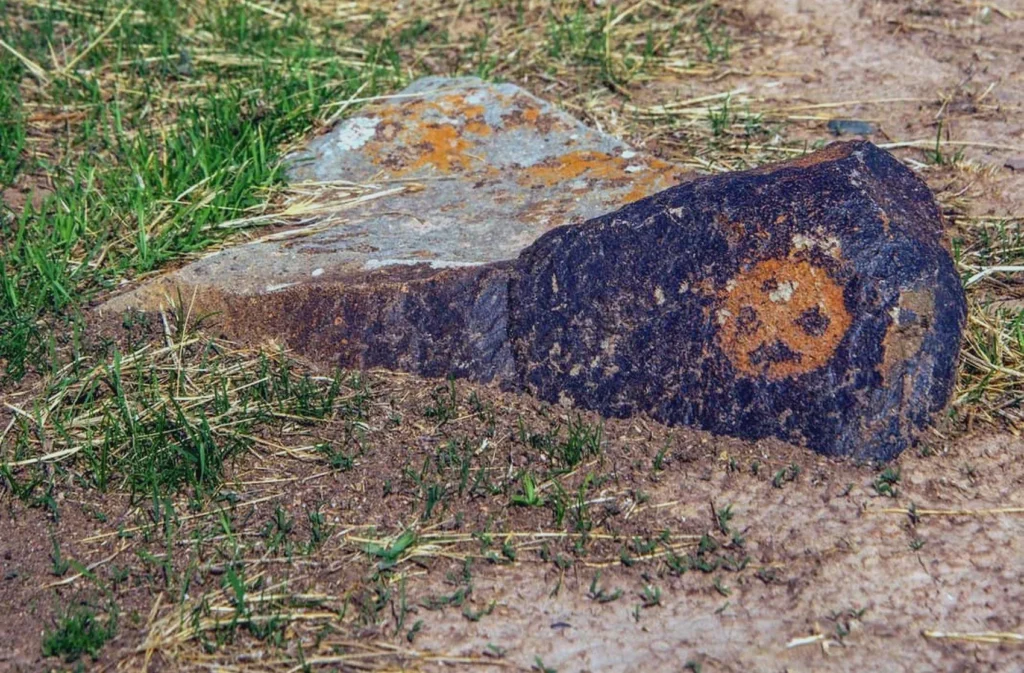
You will also find ancient stones with petroglyphs — rock carvings dated to the 16th–12th centuries BCE. One depicts the oldest man-made symbol: the Solar Cross, or Sun Wheel, frequently painted on ritual objects.
Since ancient peoples typically decorated with images only those items that were considered sacred, we can say with full confidence that here, by the ruins of medieval Balasagun, lies a truly unique collection of some of the oldest magical objects, believed to be endowed with special power.
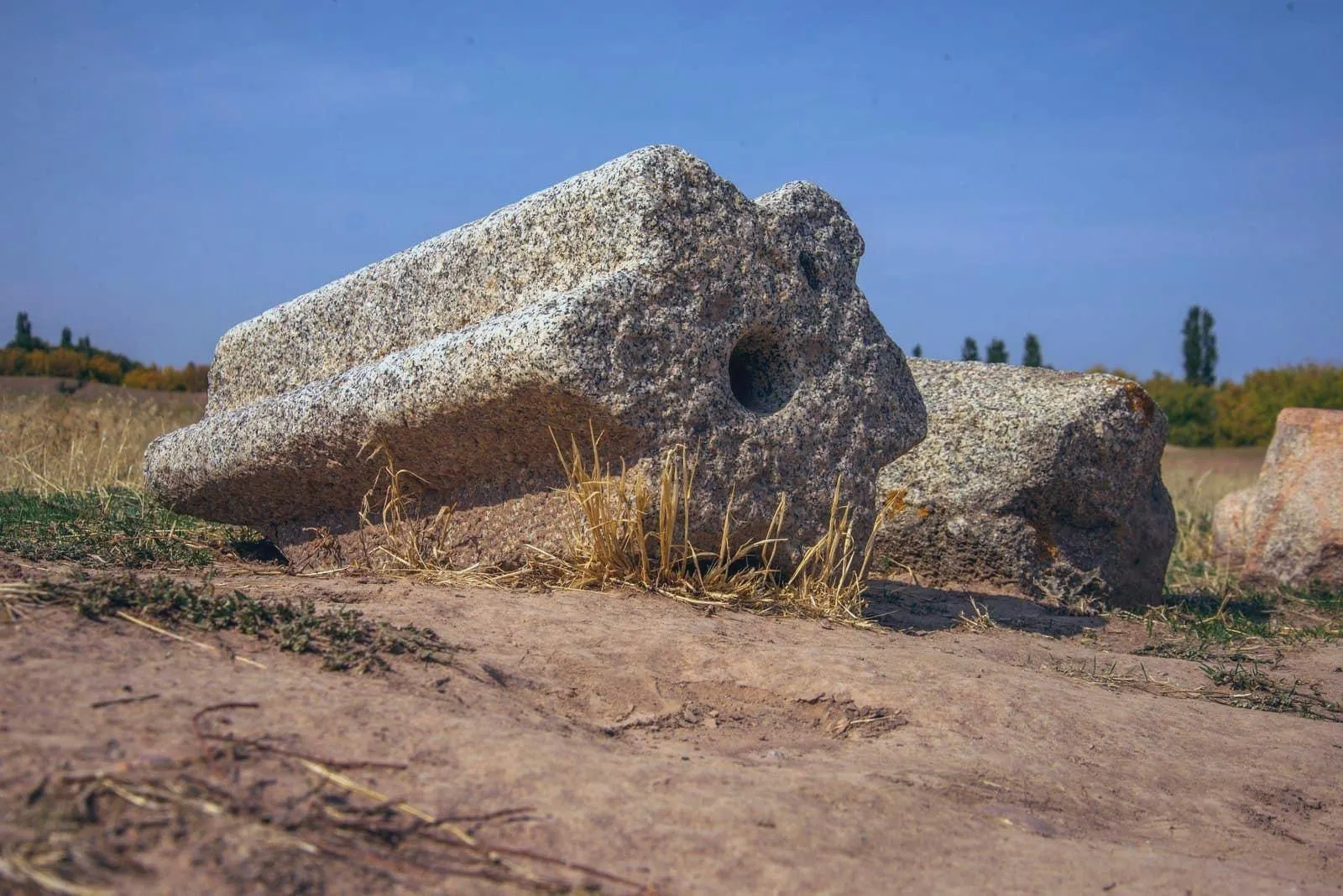
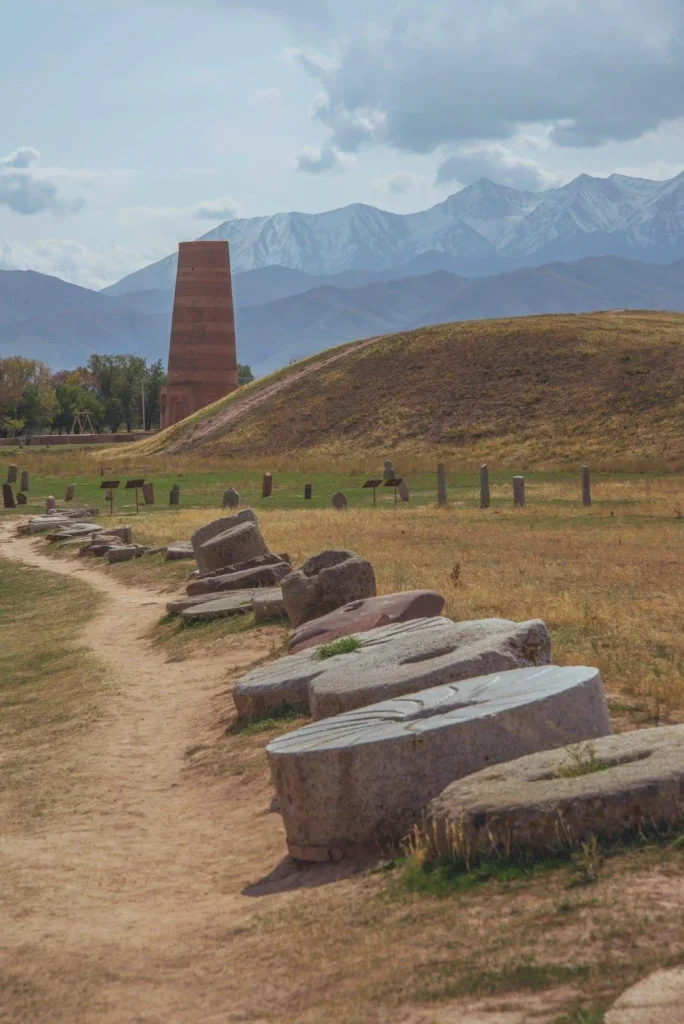
Nearby, in the Burana park, lie impressive stone millstones and threshers found on the settlement site. Carved from enormous solid blocks of granite, they were fashioned by hand, transported and mounted on axles to grind grain into flour. It is hard to imagine how this labour could have been accomplished without modern machinery, and scholars have no firm hypotheses. The Chui Valley, like the rest of Kyrgyzstan, is in no hurry to reveal all its secrets.
Text by Yulia Zemtsova
Photos by Ravshan Kazakov
Translated from Russian by Sofia Zemtsova