
Images and manuscripts recounting her story were ruthlessly destroyed, yet she survived and is gradually reclaiming her power
If you want to learn about pre-Islamic beliefs in Uzbekistan, most websites and books will only offer general statements: that Zoroastrianism was predominant in ancient times, with some Buddhism, a little Christianity, and possibly Manichaeism. Information about local deities, however, is extremely scarce — so scarce that it’s difficult to form a clear overall picture.
To gain a genuine understanding of local cults, one must delve into archaeological reports, which describe discovered objects, remnants of wall paintings, coins, and figurines sparsely and almost without commentary. From these sources, it becomes clear that in Sogd, Khwarezm, and Bactria — the regions corresponding to modern Uzbekistan — the dominant cult was that of a female deity.
The head of the Sogdian and Khwarezmian pantheon was a goddess with the beautiful name Nana, which translates as “mother” or “matron.” This form of address is still found in some Asian languages. In Russian, the word nanny has similar etymological roots. The main temple of Sogd’s capital, Marakanda (now Samarkand), was built in her honor.
The large sanctuary was richly decorated with colorful paintings and gold. Rulers spared no expense in creating altars for Nana, for she was considered the deity who granted royal authority and power.
Images and symbols of Nana appeared on coins and protective amulets, and small figurines of her were placed on household altars. Inscriptions such as ‘Nana the Great Lady’ have survived. Frescoes depicted her as a beautiful and stately young woman, crowned, dressed in royal robes, riding a lion, or sitting on it as if it were a throne.
The goddess has four arms: two rest on her knees or are folded before her chest, holding a cup and a scepter, while the other two are raised to head level, holding symbols of the sun and moon. This indicates that Nana is an astral deity, connected with celestial bodies, whose influence manifests on Earth through natural cycles.
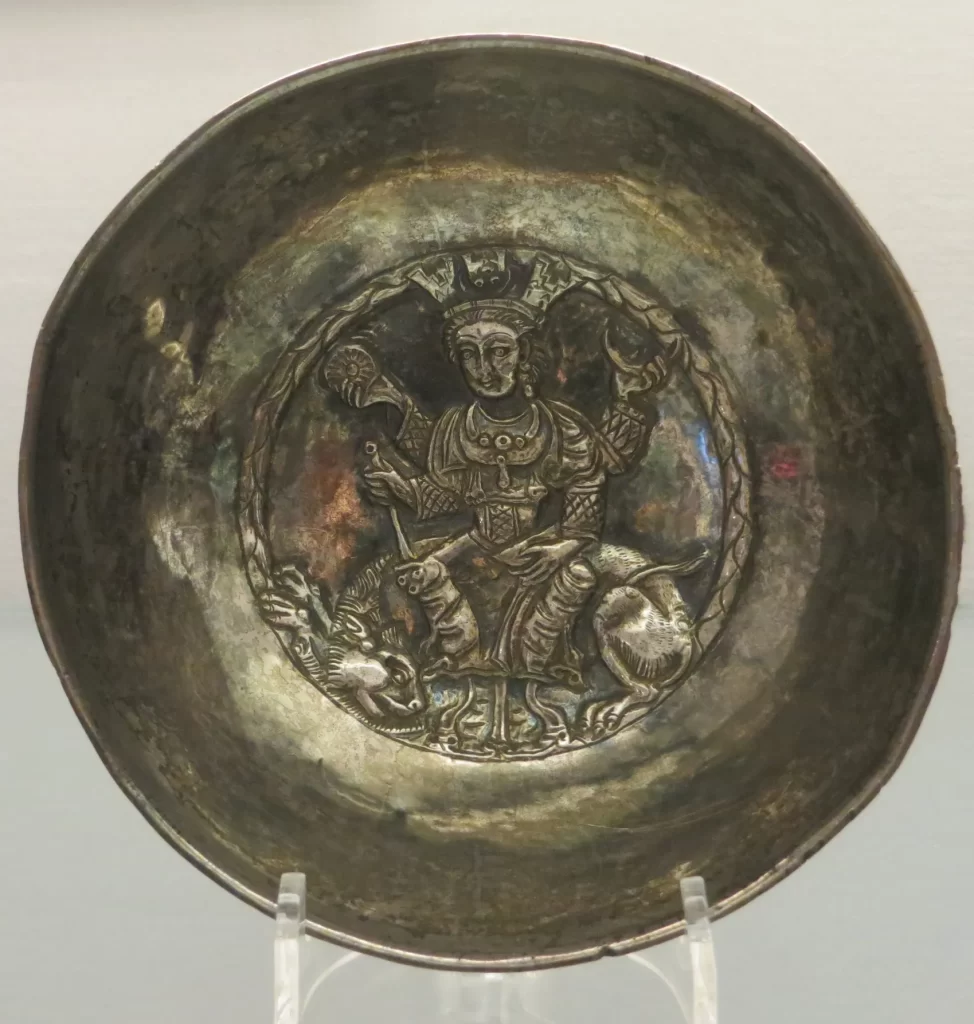
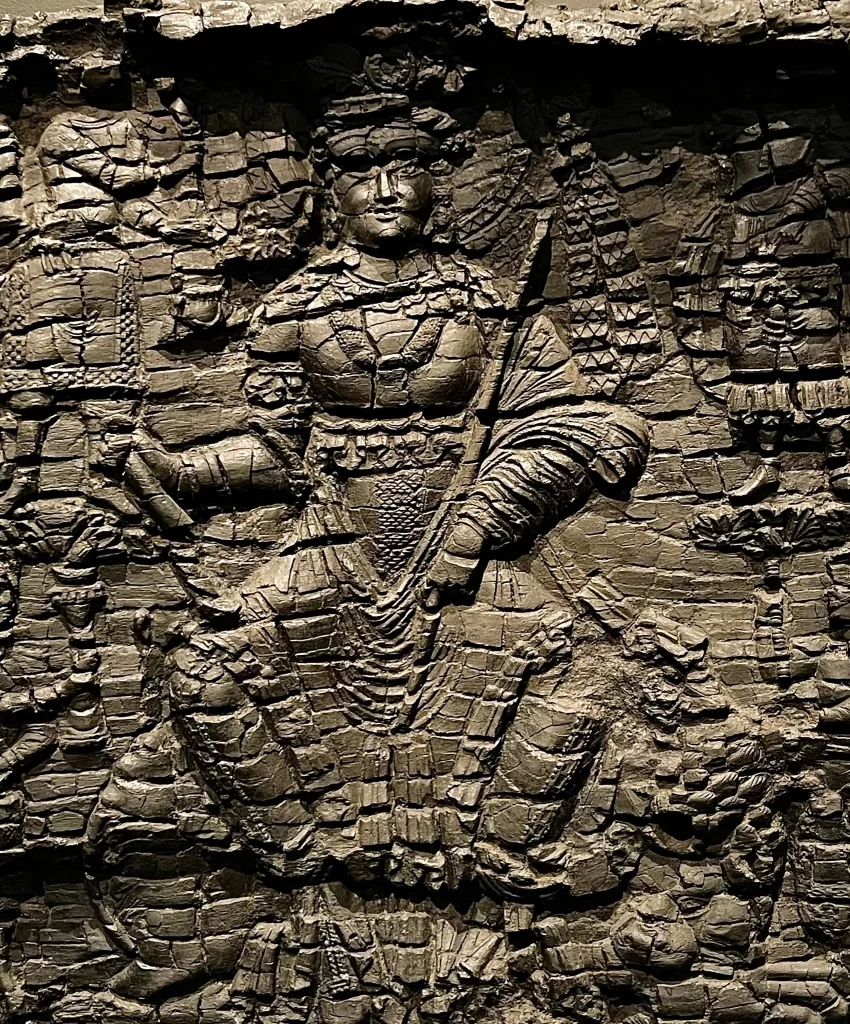
Nana is a goddess of love and war, associated with fertility, motherhood, authority, power, and victory in battles. She protected cities and royal dynasties, pregnant women, and lovers. Her images and symbols adorned not only temples but also halls for secular ceremonies. By uniting opposites, Nana served as the guardian of sacred balance throughout the universe.
She possessed farn — divine power and fortune — which she could bestow not only on kings and military leaders but also on ordinary people. Symbols of farn — rays, a ram, or ram’s horns in a double spiral — frequently appear on artifacts.
Interestingly, archaeologists have found other iconographic representations of Nana intended for domestic use throughout ancient Sogd. These small terracotta figurines show her richly dressed and crowned, but instead of human legs, she has the paws of a predatory animal.
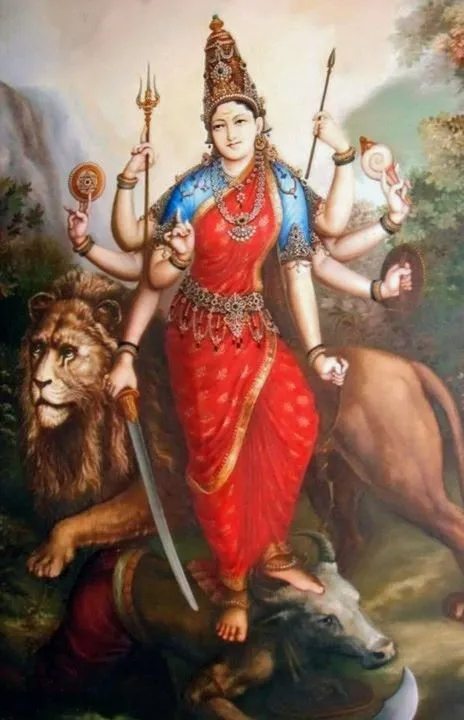
This depiction links Nana to Mesopotamian goddesses Ishtar, Inanna, and Lilith (Lilitu), who were also sometimes depicted with animal limbs. There are many parallels between Sumerian-Babylonian goddesses and the Sogdian Nana. Similar traits are also seen in the multi-armed Durga — the mother goddess of the Hindu pantheon — who rides a lion and embodies protection, power, motherhood, destruction, and war. Scholars also often draw comparisons between Nana and the Iranian goddess Anahita, goddess of water and fertility, who grants life to all living beings.


All these ancient female deities trace back to a common Mother Goddess cult that originated in the Paleolithic. The earliest ritual figurines depicting women are over twenty thousand years old. The Mother Goddess, or Great Goddess, embodies nature, life, fertility, and strength—qualities fully reflected in the subsequent cults that arose with the first civilizations.
Yet it is important not to conflate all goddesses or reduce them to a single figure. Each is unique, with its own characteristics. It is more accurate to call them “sisters” rather than incarnations of the same deity. The oldest artifacts bearing Nana’s name date to the second millennium BCE, making her over four thousand years old — comparable to Inanna and Ishtar, the first named and mythologized goddesses in human history.
Unlike the Sumerian-Babylonian goddesses, she is four-armed, and the earliest multi-armed depictions of Hindu Durga date much later, to the turn of the first millennium CE. This underscores that Nana is an independent figure, not a replica or mask.
Unfortunately, no detailed records of Nana’s cult and mythology have survived. When the Arabs conquered Sogd and Khwarezm in the 7th–8th centuries CE, they deliberately destroyed all traces of the pre-Islamic past. The famous Arab commander Qutayba ibn Muslim, who captured Samarkand, ordered the destruction of temples and the annihilation of all idols. Introducing Islam, the conquerors strictly followed its laws prohibiting depictions of humans and living beings. Thus, huge four-meter-high frescoes in wealthy homes were smashed, and statues and faces of gods were broken or burned.
Qutayba then committed an even more monstrous act: he ordered not only the burning of manuscripts but also the killing of anyone literate in Sogdian who knew the old traditions. As a result, Sogd and Khwarezm were completely cut off from their roots; their memory was literally erased. That is why so little information exists today about whom and how people worshiped before Islam.
Yet scholars have no doubt that, for millennia, the four-armed Nana was venerated in ancient Sogd and Khwarezm as the “Great Mother,” protector of major cities and a household deity whose figurines stood on altars even in the homes of the poor. And why say “was”? Who says she abandoned her land? Could a goddess simply vanish, relinquish her domain, or remove her crown to submit to a foreign god? Certainly not.
Unlike mortal humans, gods are not bound by time. What seems like 1,500 or 2,000 years to us is merely a short interval for them.
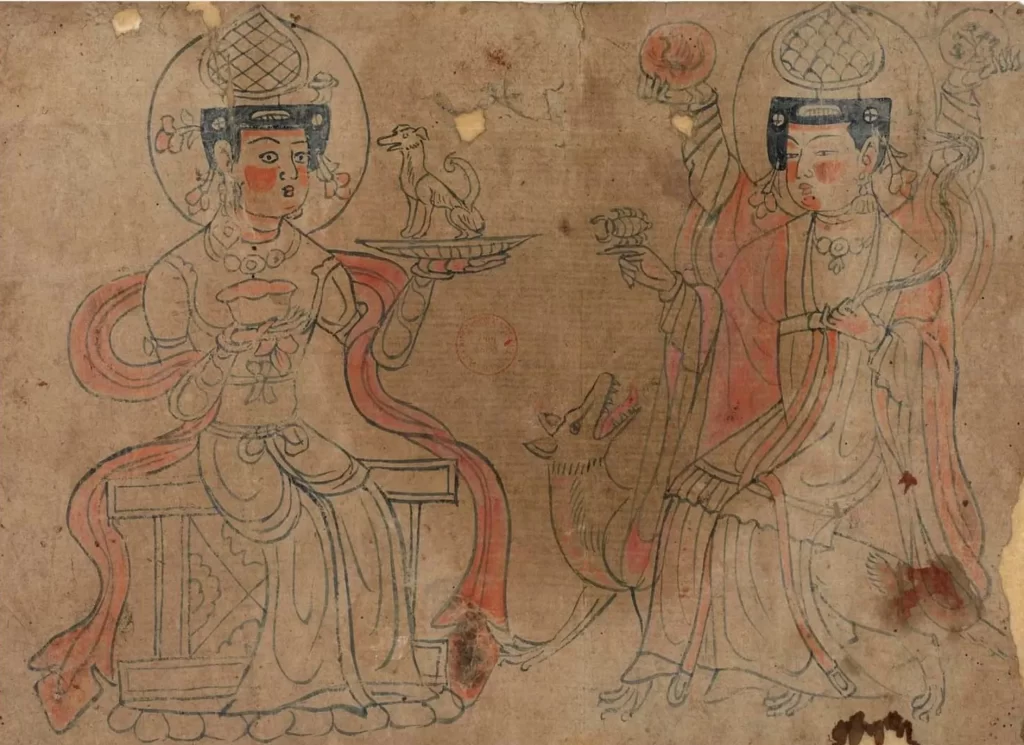
Nana is alive and gradually reclaiming her former power. A bright proof is that you are reading this text. Many archaeological sites in Uzbekistan remain unexplored, and it is highly likely that beneath layers of cultural deposits survive scrolls and books capable of revealing the secrets behind this hidden goddess.
For instance, the Nag Hammadi manuscripts—Gnostic gospels, philosophical and cosmological treatises created in the early CE period and hidden during orthodox Christian persecutions—lay buried in Egypt for nearly two thousand years. Islam has been established in Khwarezm and Sogd for only thirteen centuries. This means there is every chance we may one day learn Nana’s story and restore her pedestal.
Text by Yulia Zemtsova
Translated from Russian by Sofia Zemtsova