
Pottery — the Most Ancient Form of Magic
The earliest humans left behind no words or texts. Yet through the millennia fragments of their clay artifacts — jugs, cups, small bowls — have reached us. These are not mere utensils. They are traces of humanity’s first attempts to make something that will outlast its maker.
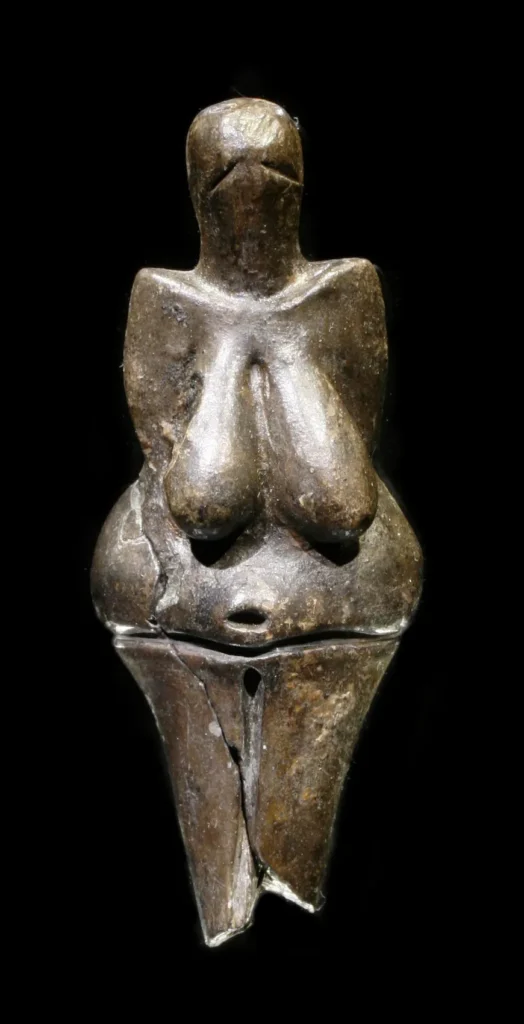
Pottery is so ancient that it’s hard even to say when it began. The oldest finds in the world date back at least 30,000 years. As Mircea Eliade wrote, the primal potter was the first to discover within himself the ability to transform matter — “yet in mythological memory this demiurgic experience left almost no trace.” Even scholars agree: pottery is a form of ancient magic, where matter, time, fire and the human touch unite in an act of creation.
From soft, formless clay a vessel is born. The void inside becomes its meaning — for it is the emptiness that allows the vessel to be filled with something precious. The analogy to the human being is striking. We, too, are shaped — by time, events, pain and love. We bend and crease, sometimes losing our form, yet in the end each of us becomes a receptacle for the universe’s greatest treasure: the immortal soul.
In ancient myth, the potter is often the maker of the world. In Mesopotamian legends, the gods fashion humans from clay mixed with their own blood. In Ancient Egypt the god Khnum forms people on a potter’s wheel. The God of the Old Testament creates man “from the dust of the ground” — the most plastic of which is clay. Time and again, across ancient cultures the figure of the first divine potter appears: the one who gives shape to chaos, breathes life into it, and takes part in the mystery of birth. Pottery is the magic of formation, the conjuring of new worlds.
The very shape of the vessel is an archetype as old as thought. The void the potter creates at the heart of the clay is not merely space for water or food; it is a symbolic womb — a receptacle, a feminine principle, an altar. All that holds, preserves and nourishes is made tangible through clay. The potter fashions form out of emptiness and silence, and in doing so participates in a primal act of creation, like the Great Goddess — the progenitor of being and bestower of life.
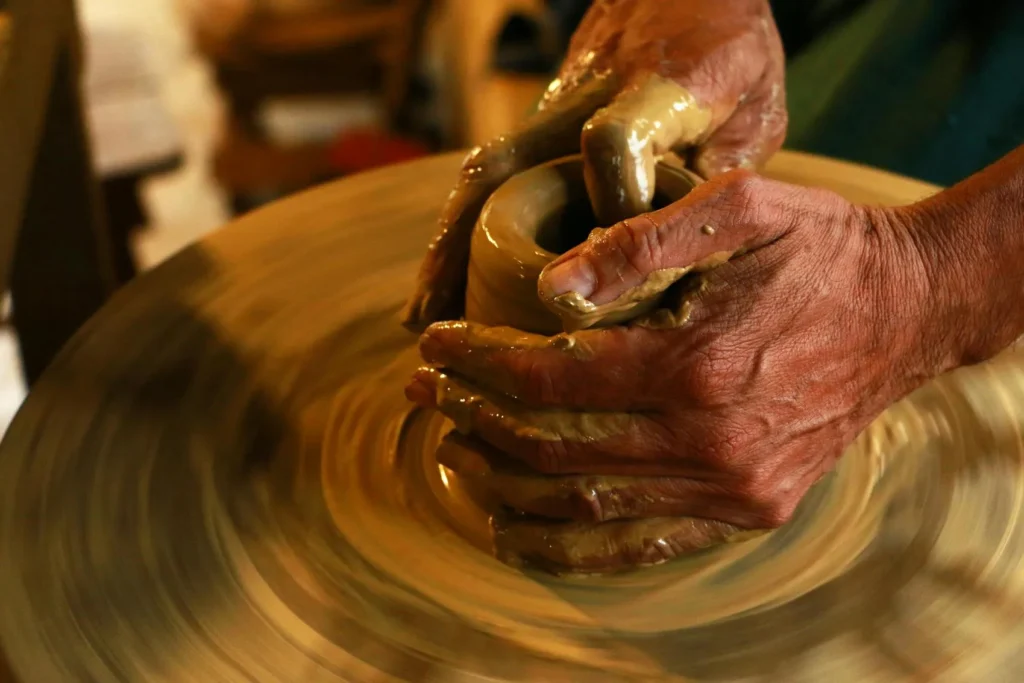
Working the earth with one’s hands — shaping the very matter of the world — restores a person to a deep bond with nature. When the hands touch soft, wet clay, they become a bridge between chaos and order, between potential and form. Giving clay deliberate form is nothing less than a tactile spell: intention, attention, absolute concentration and rhythm all matter.
But clay does not become ceramic without fire. Firing is a true alchemical passage — hard, painful, and necessary: a kind of initiation. In the fire, the vessel is either born or it cracks — just as the human soul either emerges whole or is shattered by severe trials.
So, the potter is not merely a craftsman. The potter is alchemist, shaman, mediator between earth and sky. They create not only an object but the space around it — and often the fate of those who will use it. In each vessel there remains a trace of that sacred silence in which the design itself was conceived.

Text by Yulia Zemtsova
Cover photo by Pixabay
Translated from Russian by Sofia Zemtsova